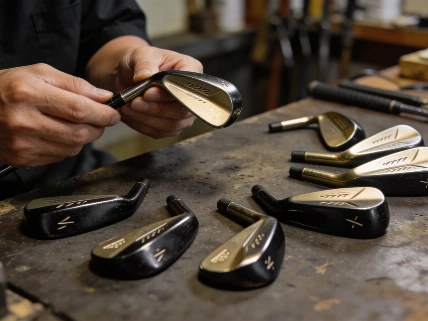
Tour testers pushed back when Ping's first S55 prototypes arrived about one-eighth of an inch larger than the S56. The finished club ended up slightly smaller, with Ping engineer Mike Nicolette describing the difference as "about a coat of paint."
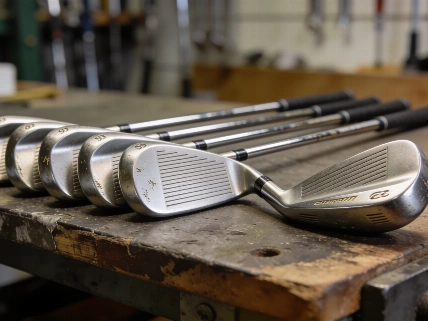
Released in 2013 as the S56 successor, the S55 was a forged cavity-back iron with a compact head and thin topline. Perimeter weighting helped raise its MOI by about 0.5 percent over the earlier model. Ping shifted discretionary weight to adjust the center of gravity.
A larger insert changes feel and weight distribution
Ping swapped the S56's thermoplastic urethane insert for a more flexible thermoplastic elastomer. The larger component, called the Custom Tuning Port, or CTP, absorbs more impact vibration. It also frees roughly 4 grams of discretionary weight for redistribution around the head. Hunter Mahan noticed a different feel while testing the irons before The Barclays.
The weight shift delivered a measurable but modest gain in forgiveness. Nicolette said a 0.5-inch mishit with a 7-iron should fly about 1 or 2 yards farther with the S55 than with the S56. For a tour player aiming at a tucked pin, those extra yards could matter.
Ping did not design the added MOI to reduce workability. Nicolette said the two models have similar MOI "above the shaft axis," so golfers need the same energy to manipulate the face into position approaching impact. The change is aimed at retaining a little more distance on off-center contact. With mass placed toward the head's edges, the cavity-back construction helps resist twisting on mishits.
Long irons launch higher while short irons stay controlled
The S55 retained essentially the S56's sole design rather than adopting progressive sole widths. Ping used the freed weight to move the long irons' center of gravity lower and farther back, helping them launch higher and travel farther. In the short irons, the center of gravity sits farther forward to encourage a lower flight.
Short-iron lofts are about 1 degree stronger. Nicolette said the change adds about 4 yards. The mid- and long-iron lofts are largely unchanged: the 6-iron is 30 degrees, 0.5 degrees stronger than the S56, while the 4-iron is 0.25 degrees weaker. Ping said the lower center of gravity should also help those clubs fly farther without creating gapping problems.
Another tour-iron design took a different tack. A Wilson prototype report described added offset and wider soles intended to increase forgiveness.
Like the S56, the S55 was cast from 17-4 stainless steel. Ping scheduled retail availability for November 1 in 3-PW, with its CFS shaft as standard. KBS Tour was available for an upcharge. The same applied to True Temper Dynamic Gold and Project X shafts.
The S55 also remained in use well beyond its launch. GolfWRX's retrospective on older tour-winning equipment notes that Matt Fitzpatrick used the irons for three tournament wins. In 2023, he said he had tested other irons but stayed with the S55 because they suited him and he had succeeded with them.