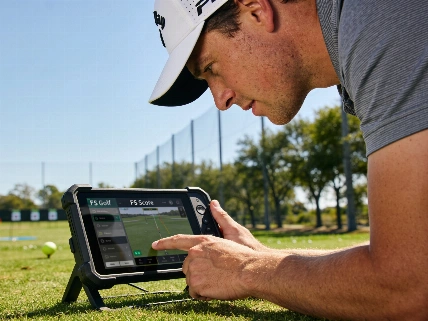
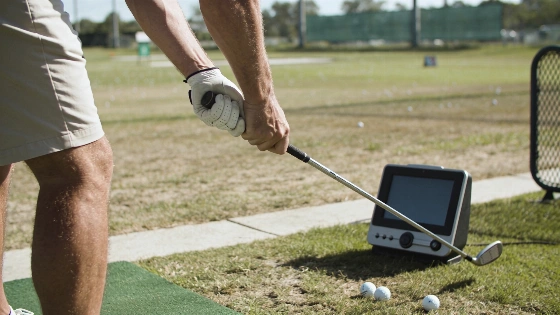
Reading a launch monitor after every swing can turn practice into a cycle of checking numbers and making instant corrections. That may feel productive. The real test is whether a golfer can retain a movement without a screen guiding each shot.
Video can create the same distraction. Replaying every attempt to check a movement may pull attention away from learning how that movement feels. Launch monitors measure results, but that is different from learning the motion behind them. The University of Ljubljana is developing a training system that gives golfers biomechanical feedback on club movement. Researchers at its Laboratory of Information Technologies in the Faculty of Electrical Engineering are studying the gap between how a swing feels and how it moves, as described in the university's golf-swing technology project.
Accurate data does not guarantee motor learning
A systematic review titled "The Missing Brain in Golf Technology: Why More Data Does Not Always Improve Performance" examined six studies on golf technology and motor learning. Its central point is straightforward: precise information does not automatically teach a golfer a skill.
The review calls this the "Technology Performance Paradox." Too little objective feedback can leave golfers relying entirely on feel, while a moderate amount can help. But processing club path and face angle after every shot takes attention. So can tracking attack angle, spin or carry. That attention could otherwise go toward practising a movement until it becomes more automatic.
Portable launch monitors can show ball speed alongside club speed. They may report launch angle and carry distance, too. Some also calculate total distance or smash factor. Others show peak height and descent angle. Systems can save club-by-club averages, display shot traces and replay video. They may also show dispersion patterns across a series. That gives golfers a way to review trends as well as individual shots, but every measure need not be checked after the same swing.
Use the screen to test your feel
Before looking at the display, make a prediction. Where did the strike land? Where did the ball start? Did the path feel more left or right? Did the carry seem longer or shorter? Checking the result afterward can connect perception with measured outcomes instead of replacing it.
Once a golfer understands the change being practised, feedback can be spaced out. Take several swings before checking the data, then make the block longer. The point is to see whether the intended movement holds up without constant prompts, not to ignore useful information or repeat poor shots.
A survey reported by Japan's FNN found that 74.5% of respondents regularly or occasionally reviewed their game after a round. Some 63.3% recorded round details. Another 76.5% set goals for the next game, while 50.5% planned to practise shots they often missed. The most common time for reflection was the day of the round, chosen by 62.7% of respondents, according to FNN's report on the Chicken Golf survey.
Practice can move from a single technical change to target-based shots. Golfers can vary trajectory or change clubs. They can also simulate a hole. Golf Digest describes differential practice as deliberately varying a movement rather than repeating one technical pattern. Golf instructor Adam Young discusses the approach in its guide to evidence-based practice methods. A launch monitor can keep recording results while the golfer adapts to different tasks instead of chasing every number.
The review covered only six studies. Its authors said direct research into golf technology's cognitive and neurological effects remains scarce. The review does not prove that checking data after every swing worsens performance; it identifies a reason to distinguish feedback from learning.