
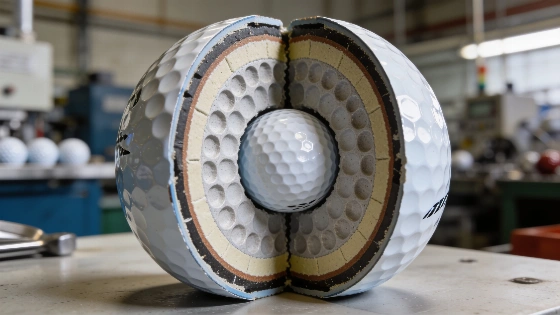
Engineers pack every golf ball with specialized materials and exacting design. Each layer and dimple changes how the ball flies, spins, and feels in real-world play.
Step onto any tee box and the real work behind a golf ball is already done. The outcome of a drive or a wedge shot often traces back to choices made in the lab and on the production line, where every layer and dimple gets its marching orders.
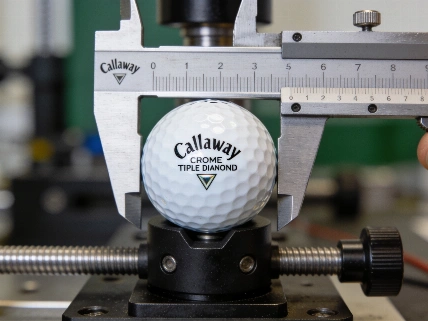
According to USGA and R&A rules, a golf ball must not exceed 1.620 ounces (45.93 grams) in mass and must have a minimum diameter of 1.680 inches (42.67 mm).
From Feathers to Five Layers The Evolution of Golf Ball Design
Golf's earliest balls, the "feathery," were stitched leather stuffed with goose feathers. They cost a fortune and played inconsistently, so only the wealthy could afford them. The gutta-percha ball, made from tree sap, arrived in the 1800s and changed the game. Players noticed that scuffed surfaces helped balls fly farther, so texture became part of the design.
In 1898, the Haskell ball landed with a rubber core and a gutta-percha shell. This jump in distance and reliability set the template for the modern ball. Today, synthetic materials and aerodynamic tweaks rule the market. Companies build balls with two to five layers, each one targeting distance or spin for a specific type of player.
How Modern Golf Balls Are Built Layer by Layer
The core sits at the center, usually made from polybutadiene rubber. This synthetic rubber gives the ball its bounce and controls compression. Softer cores help slower swings get more distance. Firmer cores suit faster swings. A US patent filing details how modern balls may use several intermediate layers, each shaped by compression or molding to fine-tune how the ball reacts off the clubface.
The manufacturing process for golf ball covers often uses molds with negative dimple patterns, where raised features inside the mold create the signature dimples on the finished ball's surface.
The outer cover decides feel and toughness. Urethane covers give a softer touch and more spin, so pros lean on them for control near the green. Surlyn and other ionomer covers are harder and last longer, making them a fit for players who want durability or extra distance. Product sheets often tout Surlyn for toughness and distance, and urethane for spin and feel, but most of these claims come from marketing, not independent head-to-head tests.
Dimples do the heavy lifting in flight. Patterns range from 300 to 500 per ball, each one shaped to cut drag and boost lift. The depth and layout of dimples can shift how a ball handles wind or holds its line. NASA has even borrowed dimple science for spacecraft. A specialized engineering analysis explains that dimples create a turbulent boundary layer, keeping airflow attached longer and cutting drag compared to a smooth ball.
Material Choices and the Push for Sustainability
Golf balls blend synthetic rubber, ionomer resins, and plastic-based polymers. The outer shell is usually plastic-derived, while the core and inner layers rely on rubber for bounce and energy return. This mix keeps performance steady in different weather and course conditions.
Standard golf balls do not break down in nature, so lost balls in water or rough raise environmental flags. Some companies now offer biodegradable balls made from cornstarch or fish food, and others push recycled or refurbished options. Packaging is also shifting toward greener materials as the industry faces pressure to clean up its act.
Calling a golf ball "just plastic" misses the mark. The shell may be plastic, but the inside is mostly synthetic rubber. Each material is picked for a reason tied to how the ball plays.
Every spec, from core compression to dimple count, is a calculated move. Pro-level ball speeds have topped 220 mph, and most balls pack between 336 and 392 dimples. These numbers are set by design, not by chance.